
Conduit bending relies on manual tables detailing measurements for accurate tubo conduit shaping; these tables aid electricians in calculating bends and offsets effectively.
What is Conduit?
Conduit serves as a protective raceway for electrical wiring‚ shielding it from damage and environmental factors. Utilizing a manual tabla de medidas para doblar tubo conduit is crucial for correctly installing these pathways. Different materials—like EMT‚ IMC‚ and rigid—require specific bending techniques detailed within these tables. These tables provide precise measurements‚ ensuring accurate bends and offsets for safe and compliant electrical systems. Understanding conduit types and their corresponding bending data‚ found in these manuals‚ is fundamental for any electrician. Proper conduit installation guarantees long-term reliability and safety.
Why Use a Bending Table?
Employing a manual tabla de medidas para doblar tubo conduit eliminates guesswork in electrical installations. These tables provide precise data for calculating bend allowances‚ take-up values‚ and gain‚ ensuring accurate conduit runs. Without these tables‚ achieving correct angles and offsets becomes significantly more challenging‚ potentially leading to wasted material and code violations. They streamline the bending process‚ saving time and labor costs. Accurate bending‚ guided by these manuals‚ minimizes the risk of kinks‚ wrinkles‚ and improper fits‚ guaranteeing a professional and safe outcome.

Understanding Conduit Sizes
Conduit size selection‚ informed by manual tablas‚ dictates bending parameters; understanding trade size versus actual dimensions is crucial for accurate tubo conduit work.
Common Conduit Sizes (EMT‚ IMC‚ Rigid)
Electrical Metallic Tubing (EMT) is lightweight and commonly used for indoor applications‚ while Intermediate Metal Conduit (IMC) offers greater strength. Rigid Metal Conduit (RMC) provides the highest level of protection and durability‚ suitable for harsh environments.
Manual tablas de medidas are essential for each type‚ detailing bending allowances and deductions. These tables account for variations in wall thickness and diameter‚ ensuring precise bends for tubo conduit. Selecting the correct size‚ guided by electrical codes and load requirements‚ is paramount before consulting bending tables.
Conduit Trade Sizes vs. Actual Dimensions
Conduit is designated by “trade size‚” which doesn’t reflect the actual outer diameter. A ½” trade size conduit‚ for example‚ has an outer diameter closer to ¾”. Understanding this distinction is crucial when using manual tablas de medidas para doblar tubo conduit.
These tables are calibrated based on trade sizes‚ not actual dimensions. Accurate bending relies on referencing the correct trade size and corresponding values within the tabla. Ignoring this difference leads to miscalculations and improper fitting of the tubo conduit‚ potentially violating electrical codes;

Essential Tools for Conduit Bending
Manual tablas de medidas are vital‚ alongside hand benders‚ tape measures‚ and protractors‚ for precise tubo conduit bending and accurate electrical installations.
Hand Benders
Hand benders are fundamental for field adjustments utilizing a manual tabla de medidas para doblar tubo conduit. These tools‚ available in various sizes corresponding to conduit diameter‚ allow electricians to create precise bends without power. Understanding the bender’s hook radius and applying the correct table values are crucial.
Proper technique‚ combined with accurate table readings‚ minimizes kinks and ensures consistent‚ code-compliant bends. Electricians must select the appropriate bender for the tubo conduit size and carefully follow the table’s instructions for take-up and gain to achieve desired angles and offsets.
Hydraulic Benders
Hydraulic benders offer significant mechanical advantage when bending larger diameter tubo conduit‚ still requiring a manual tabla de medidas para doblar tubo conduit for accurate results. These benders reduce physical strain‚ enabling consistent bends‚ especially in demanding installations. They utilize hydraulic pressure to form bends‚ minimizing effort.
Despite the power assistance‚ precise table interpretation remains vital. Electricians must correctly set the bender’s parameters based on the table’s take-up and gain values to avoid over or under-bending. Proper operation ensures smooth‚ accurate bends‚ even with rigid conduit types.
Measuring Tools (Tape Measure‚ Protractor)
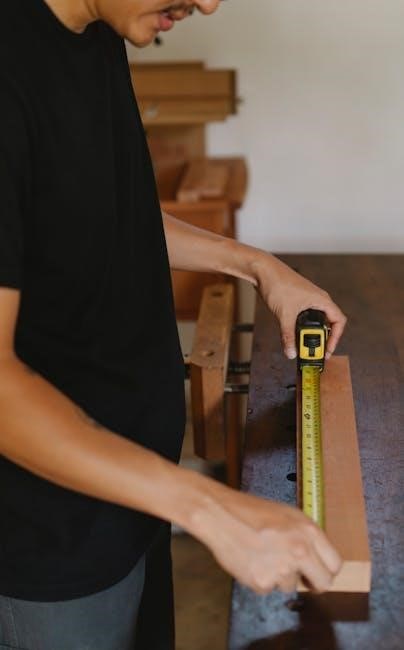
Accurate measurements are paramount when utilizing a manual tabla de medidas para doblar tubo conduit. A reliable tape measure ensures precise conduit length calculations before bending‚ minimizing waste and ensuring proper fit. Protractor use verifies bend angles‚ confirming alignment with project specifications and the table’s indicated values.
Combining these tools with the table allows for meticulous layout and execution. Careful measurement of take-up and gain‚ as dictated by the table‚ is crucial for achieving desired offsets and bends. Consistent verification prevents costly errors and rework during installation.

Reading a Conduit Bending Table
A manual tabla de medidas para doblar tubo conduit details crucial data: size‚ bend angle‚ take-up‚ and gain—essential for precise conduit manipulation and layout.
Understanding Table Columns (Size‚ Bend Angle‚ Take-Up‚ Gain)
Manual tablas for tubo conduit bending present columns defining key parameters. ‘Size’ indicates the conduit’s trade size (e.g.‚ ½”‚ ¾”). ‘Bend Angle’ specifies the degree of the bend. ‘Take-Up’ represents the amount of conduit consumed during the bend‚ crucial for accurate layout. ‘Gain’ denotes the distance between the starting and ending points of the bend‚ aiding in precise measurements.
Understanding these columns is vital; take-up dictates how much extra conduit is needed‚ while gain helps determine the final run length. Correctly interpreting these values ensures accurate bends and avoids costly errors during installation‚ utilizing the manual tabla de medidas effectively.
How to Interpret Take-Up Values
Interpreting ‘Take-Up’ values from a manual tabla de medidas for tubo conduit is fundamental. Take-up isn’t the actual bend radius‚ but the length of conduit lost within the bend itself. Electricians must add this value to their initial measurements to compensate for the material consumed during forming.
For instance‚ a 90-degree bend might have a take-up of 6 inches. This means 6 inches of conduit are effectively ‘used up’ in creating the bend‚ requiring an extra 6 inches in the initial cut length. Accurate take-up interpretation prevents short conduit runs.
Understanding Shrinkage and Stretch
When utilizing a manual tabla de medidas para doblar tubo conduit‚ comprehending shrinkage and stretch is crucial. Bending conduit causes material displacement; bends shrink the distance between the starting and ending points on the inside of the bend. Conversely‚ the outside of the bend experiences stretch‚ effectively lengthening that arc.
These effects are quantified in bending tables. Ignoring shrinkage/stretch leads to inaccurate layouts. The table provides values to account for these changes‚ ensuring conduit fits precisely within the intended electrical system design‚ avoiding costly rework.
Bending Calculations & Formulas
Manual tablas for tubo conduit bending necessitate calculations for bend allowance‚ take-up‚ and gain‚ ensuring accurate offsets and proper fitting alignment.
Calculating Bend Allowance
Determining bend allowance when using a manual tabla de medidas para doblar tubo conduit is crucial for precise bends; This allowance compensates for material shrinkage during the bending process‚ preventing gaps or overlaps in the final installation. Electricians consult the tabla to find specific values based on conduit size and bend angle.
The bend allowance isn’t a fixed number; it varies depending on the conduit type (EMT‚ IMC‚ Rigid) and the degree of the bend. Accurate calculation‚ referencing the tabla‚ ensures the conduit follows the intended path without requiring rework. Ignoring this allowance leads to inaccurate layouts and potential code violations.
Determining Total Take-Up for Multiple Bends
When making multiple bends in tubo conduit using a manual tabla de medidas‚ calculating total take-up is essential. Take-up‚ found within the tabla‚ represents the amount of conduit consumed during each bend. Simply adding individual take-up values isn’t always accurate due to compounding effects.
For complex layouts‚ electricians must consider the cumulative impact of each bend on the overall conduit length. The tabla provides data for individual bends‚ but experienced professionals often apply a slight adjustment factor to account for these interactions. Precise take-up calculation minimizes waste and ensures proper fit.
Offset Formulas
Creating offsets in tubo conduit‚ guided by a manual tabla de medidas‚ requires specific formulas. The primary formula calculates the distance between bends‚ factoring in the desired offset distance and the bend angle; The tabla provides crucial bend data‚ like take-up and gain‚ needed for accurate calculations.
Electricians utilize these formulas to determine the precise measurements for each bend‚ ensuring the conduit navigates around obstructions effectively. Understanding the relationship between offset distance‚ angle‚ and conduit size—detailed in the tabla—is vital for a clean‚ professional installation.

Specific Bending Techniques
Employing a manual tabla de medidas‚ techniques like 90-degree bends and offsets demand precise execution for tubo conduit‚ ensuring accurate angles and dimensions.
90-Degree Bends
Achieving precise 90-degree bends in tubo conduit necessitates careful utilization of a manual tabla de medidas. This table provides critical data‚ including the bend allowance and take-up required for the specific conduit size and type. Electricians consult the table to determine the exact mark on the conduit where the bending should commence.
Proper technique involves securely anchoring the conduit‚ applying consistent pressure during the bend‚ and verifying the final angle with a protractor. Incorrect measurements from the tabla or improper bending can result in bends that are either too acute or too obtuse‚ compromising the installation’s integrity and code compliance.
Offset Bends
Creating offset bends in tubo conduit demands precise application of a manual tabla de medidas. These tables detail the cumulative take-up needed for parallel offsets‚ factoring in the desired distance and conduit size. Electricians utilize the table to calculate the necessary bend angles and distances between bends‚ ensuring a smooth‚ level run.
Offset bends typically involve two equal bends‚ and the tabla assists in determining the correct spacing. Accurate measurements are crucial; errors can lead to offsets that don’t meet specifications or create unwanted stress on the conduit‚ potentially causing future failures.
Saddle Bends
Saddle bends‚ used to clear obstructions in tubo conduit runs‚ require careful calculation using a manual tabla de medidas. The table provides data for determining the rise‚ run‚ and gain associated with these bends‚ ensuring the conduit clears the obstacle without excessive height or length.
Electricians consult the tabla to find the appropriate bend angles based on the obstruction’s size and location. Precise application of these measurements is vital for a clean‚ professional installation. Improper saddle bends can create stress points or fail to adequately clear the obstruction.

Bending Tables for Different Conduit Types
Manual tablas de medidas vary by tubo conduit type—EMT‚ IMC‚ and Rigid—each demanding specific bending calculations for accurate and safe installations.
EMT Conduit Bending Table
EMT conduit bending tables‚ often found as manual tablas de medidas‚ are crucial for electricians working with Electrical Metallic Tubing. These tables provide essential data‚ including bend angles‚ take-up lengths‚ and gain‚ necessary for precise 90-degree bends‚ offsets‚ and saddle bends. Understanding these values prevents kinks and ensures smooth conduit runs. Tables detail how much conduit must be added (take-up) to compensate for the shortening during bending. Different tables exist based on the bending radius‚ commonly 3-bend or 4-bend methods. Accurate interpretation of these tables is vital for compliant and professional electrical installations‚ minimizing material waste and rework.
IMC Conduit Bending Table
IMC conduit bending tables‚ or manual tablas de medidas‚ are specifically designed for Intermediate Metal Conduit‚ differing from EMT due to its thicker walls. These tables detail the necessary adjustments for bending IMC‚ accounting for its greater rigidity and reduced ductility. Key data includes bend angles‚ take-up values‚ and gain‚ crucial for accurate offsets and bends. Electricians utilize these tables to calculate the required conduit length‚ compensating for shrinkage or stretch during the bending process. Proper use minimizes errors‚ ensuring secure and code-compliant installations. Understanding the specific table for IMC is essential for professional results.
Rigid Conduit Bending Table
Rigid conduit bending tables‚ often referred to as manual tablas de medidas‚ are essential for working with the heaviest type of metallic conduit. These tables account for rigid conduit’s substantial wall thickness and minimal flexibility‚ requiring precise calculations. They provide data for bend angles‚ take-up‚ and gain‚ vital for achieving accurate bends and offsets. Due to its rigidity‚ bending requires more force and careful planning. Utilizing the correct table ensures proper compensation for minimal stretch and significant shrinkage during the bending process‚ leading to compliant and durable installations.
Advanced Bending Concepts
Advanced conduit bending‚ even with manual tablas de medidas‚ involves understanding K-factors and multipliers for complex bends‚ ensuring precise tubo conduit layouts.
K Factor and its Application
The K-factor‚ crucial in conduit bending‚ accounts for variations in bend radius and tubo conduit diameter‚ impacting accurate measurements. Utilizing a manual tabla de medidas alone isn’t sufficient for complex bends; the K-factor adjusts calculations for these discrepancies.
It’s a multiplier applied to take-up and gain values found in bending tables‚ ensuring precise offsets and minimizing errors. Different conduit types (EMT‚ IMC‚ Rigid) possess unique K-factors. Correctly applying this factor‚ alongside the tabla‚ is vital for professional electrical installations‚ guaranteeing code compliance and structural integrity of the tubo conduit system.
Multi-Bend Calculations
When navigating complex routing with tubo conduit‚ multi-bend calculations become essential‚ extending beyond simple manual tabla de medidas lookups. These calculations determine cumulative take-up for several bends‚ accounting for their interaction.
Offsets requiring multiple bends demand precise addition or subtraction of take-up values‚ considering bend angles and conduit type. Ignoring this cumulative effect leads to significant errors. Utilizing the K-factor alongside the tabla is crucial for accuracy. Mastering these calculations ensures a smooth‚ code-compliant installation of the conduit system.
Using Bending Multipliers
Bending multipliers refine calculations when working with tubo conduit‚ especially when deviations from standard manual tabla de medidas are necessary. These multipliers adjust take-up and gain values based on conduit size and bend angle‚ ensuring precision.
Factors like conduit material (EMT‚ IMC‚ Rigid) influence multiplier selection. Applying the correct multiplier compensates for variations in conduit wall thickness and diameter. Accurate multiplier use minimizes errors‚ particularly in complex bends or offsets. Always consult reliable resources alongside the tabla for appropriate multiplier values‚ guaranteeing a professional result.

Troubleshooting Common Bending Problems
Incorrect bends with tubo conduit often stem from misinterpreting the manual tabla de medidas; wrinkles or kinks indicate improper technique or force application.
Dealing with Wrinkles and Kinks
Wrinkles and kinks in bent tubo conduit frequently arise from exceeding the conduit’s allowable bending radius‚ or applying uneven pressure during the bending process. Consulting a manual tabla de medidas para doblar tubo conduit is crucial; it provides the correct bending parameters.
Minor wrinkles might be carefully worked out with a mallet‚ but severe kinks necessitate recutting the conduit. Always ensure the bender’s shoes are properly aligned and lubricated. Incorrectly referencing the tabla can lead to these issues‚ emphasizing the need for accurate measurement and careful execution.
Correcting Over-Bends and Under-Bends
Over-bends and under-bends occur when the bending process deviates from the angles specified in a manual tabla de medidas para doblar tubo conduit. A slight over-bend can sometimes be corrected by gently applying reverse pressure‚ but avoid excessive force.
Under-bends usually require re-bending‚ carefully referencing the tabla to achieve the correct angle. Consistent use of the tabla’s data minimizes these errors. Always double-check measurements before and after each bend to ensure accuracy and prevent wasted material or rework.
Addressing Springback
Springback‚ the tendency of tubo conduit to return slightly towards its original shape after bending‚ is a crucial consideration when using a manual tabla de medidas para doblar tubo conduit. The tabla accounts for this by providing slightly greater bend allowances.
Experienced benders learn to anticipate springback‚ but beginners should consistently verify angles post-bend. Minor springback can be corrected with careful adjustments‚ while significant springback indicates a potential issue with technique or the tabla’s application.

Safety Precautions When Bending Conduit
Always wear appropriate PPE when using a manual tabla de medidas para doblar tubo conduit‚ prioritizing eye protection and gloves for safe‚ accurate bending.
Proper Personal Protective Equipment (PPE)
When utilizing a manual tabla de medidas para doblar tubo conduit‚ prioritizing personal safety is paramount. Essential PPE includes sturdy work gloves to protect hands from abrasions and sharp conduit edges during bending operations. Safety glasses or a face shield are crucial‚ safeguarding eyes from flying debris or metal fragments.
Appropriate work boots with steel toes offer foot protection against dropped conduit or tools. Depending on the work environment‚ hearing protection might be necessary. Ensure clothing is snug-fitting to avoid entanglement with bending equipment‚ and a hard hat is recommended in construction zones. Regularly inspect PPE for damage and replace it as needed to maintain optimal protection while referencing the bending table.
Safe Bending Practices
Employing safe practices when using a manual tabla de medidas para doblar tubo conduit is vital. Always ensure a stable work surface and adequate lighting for clear visibility. Before bending‚ inspect the conduit for any defects. Securely clamp the conduit in the bender‚ following the manufacturer’s instructions.
Apply steady‚ controlled pressure during bending‚ avoiding jerky movements. Never exceed the bender’s capacity. Be mindful of pinch points and keep hands clear of bending mechanisms. Double-check measurements against the table after each bend. Maintain situational awareness and avoid distractions to prevent errors and injuries.
Avoiding Conduit Damage
When utilizing a manual tabla de medidas para doblar tubo conduit‚ preventing damage is crucial. Overbending or applying excessive force can cause kinks and weaken the conduit’s structural integrity. Incorrect bender sizing or improper clamping can lead to deformation. Always select the correct bender die for the conduit size and type.
Avoid sharp‚ sudden bends‚ opting for gradual curves as indicated by the bending table. Regularly inspect the conduit for cracks or flattening during the bending process. Proper lubrication can reduce friction and minimize the risk of damage. Careful measurement and adherence to the table’s specifications are key.

Resources for Conduit Bending
Manual tablas de medidas for tubo conduit bending are readily available online and from electrical supply houses‚ aiding precise and efficient installations.
Online Conduit Calculators
While traditional manual tablas de medidas para doblar tubo conduit remain valuable‚ numerous online calculators streamline the bending process. These digital tools often incorporate various conduit types – EMT‚ IMC‚ and Rigid – and allow users to input parameters like bend angle‚ conduit size‚ and desired offset.
The calculators then output critical measurements‚ including take-up‚ gain‚ and shrink‚ eliminating the need for manual table lookups. Some advanced calculators even account for K-factors and multi-bend scenarios‚ enhancing accuracy and efficiency. However‚ it’s crucial to verify calculator results against established bending tables for confirmation and understanding.
Bending Table Apps
Modern electricians increasingly utilize bending table applications on smartphones and tablets‚ offering a digital alternative to manual tablas de medidas para doblar tubo conduit. These apps typically feature comprehensive databases covering various conduit sizes and materials‚ providing instant access to crucial bending data.
Many apps include built-in calculators for offset and multiplier calculations‚ simplifying complex bends. Some even offer visual guides and tutorials. While convenient‚ it’s essential to ensure the app is regularly updated and sourced from a reputable developer to maintain accuracy and reliability‚ complementing—not replacing—fundamental bending knowledge.
Industry Standards and Codes
Adhering to industry standards is paramount when utilizing manual tablas de medidas para doblar tubo conduit. The National Electrical Code (NEC) dictates safe installation practices‚ including conduit bending requirements‚ ensuring electrical systems are compliant and secure. Local amendments may also apply‚ necessitating awareness of regional regulations.
Proper bending techniques‚ guided by these standards‚ minimize stress on conduit and fittings‚ preventing failures. Regularly consulting updated codebooks and participating in continuing education are crucial for electricians to remain current with evolving safety protocols and maintain professional competence in conduit work.